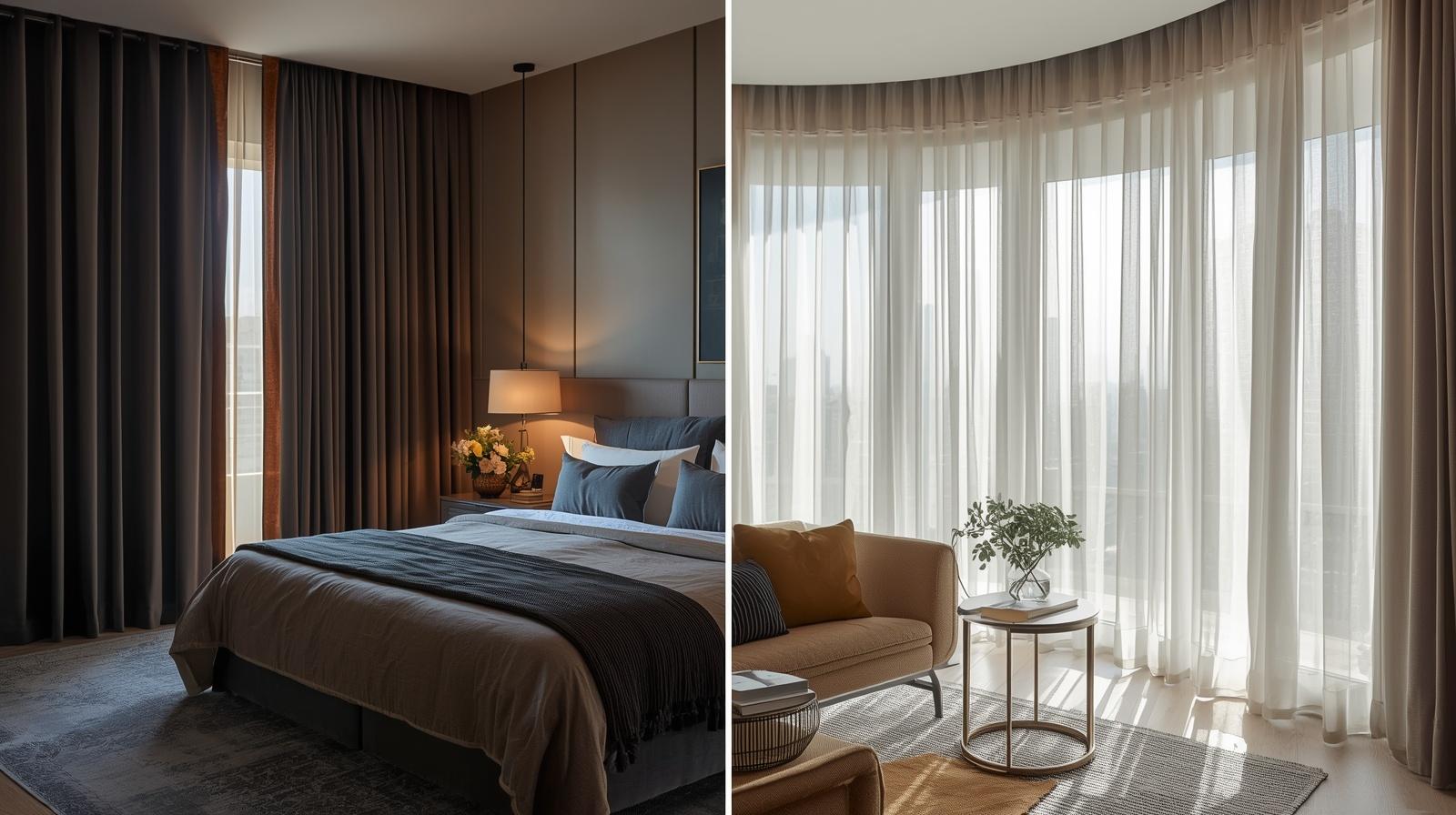
The best curtains for Dubai homes are thermal blackout curtains for west-facing and high-sun rooms, UV-treated linen blends for living areas, and a layered sheer-plus-thermal-drape system for rooms that need to adapt between morning comfort and peak afternoon heat.
Always choose these three things:
- Light-colored, floor-length panels with bonded thermal or blackout lining.
- Ceiling-to-floor installation with zero edge gaps on any side.
- Solution-dyed fabrics over surface-dyed ones for long-term color durability in Dubai’s harsh UV conditions.
Motorized curtain systems are no longer a luxury in Dubai. They are the most effective way to guarantee curtains are closed during peak heat hours – the precise moment when most manual systems are accidentally left open.
WHY DUBAI’S CLIMATE DEMANDS SMARTER CURTAIN CHOICES
Almost every curtain-buying guide published online was written for Europe or North America. Those guides were built around climates where the primary challenge is keeping warmth in during winter – not defending against brutal, year-round heat, extreme UV radiation, and relentless desert dust simultaneously.
When Dubai homeowners apply those generic recommendations here, the results are predictable and costly:
- Faded fabrics that look years older after just one summer.
- Rooms that overheat despite the air conditioning running at full power.
- DEWA bills that spike every summer without a clear explanation.
- Curtains that deteriorate within one to two seasons rather than lasting years.
Dubai is classified as a BWh climate – hot desert – under the Köppen-Geiger system. Summer temperatures regularly exceed 43°C, and the highest recorded temperature in Dubai hit 50.1°C in July 2023. The sun does not ease up during winter. It simply becomes slightly less punishing. Add the coastal humidity of areas like Dubai Marina, Palm Jumeirah, JBR, and Business Bay, and the environment becomes genuinely hostile to any standard interior fabric.
What makes Dubai’s situation uniquely difficult is not the heat alone. Three entirely different environmental forces attack your windows, your furniture, and your energy bill at the same time – and standard curtains are not engineered to handle any one of them properly, let alone all three together.
This guide was written entirely for Dubai’s actual living conditions – not borrowed from an international interior design blog and lightly edited. Whether you live in a studio in JVC, a townhouse in Mirdif, a high-rise in Downtown Dubai, or a villa on Palm Jumeirah, every recommendation here reflects the environment you actually live in.

THE THREE THREATS EVERY DUBAI CURTAIN MUST DEFEND AGAINST
Understanding what your curtains are up against is the foundation of a smart buying decision in the UAE. Every Dubai home faces three distinct climate threats daily. The best curtain for a Dubai home is the one that addresses all three – not just the most obvious one.
EXTREME UV RADIATION
Dubai’s UV Index is classified as Extreme – the highest category on the World Health Organization’s scale – from March through August every single year. It peaks at UV Index 12 in May and holds between 10 and 11 from June through August. A UV Index above 11 means unprotected skin can begin to burn in as little as 10 minutes of midday exposure.
This is not just a sun safety concern for outdoor activity. This is a year-round interior design and furniture protection problem that costs Dubai homeowners real money every season.
What UAE-level UV radiation does to an unprotected home interior:
- Upholstered sofas and dining chairs fade, crack, and become brittle.
- Hardwood, engineered wood, and laminate flooring bleach unevenly and permanently.
- Rugs, artwork, and decorative objects lose color and structural integrity.
- Curtain fabric itself degrades – often faster than the furnishings it was meant to protect.
Furniture that lasts fifteen years in a European home will show significant fading and breakdown in three to five years if Dubai’s sunlight reaches it through unprotected glass.
The key metric to ask for when evaluating curtain fabric:
UV Transmission Rate – the percentage of ultraviolet radiation that passes through the material. Lower is always better.
- Solution-dyed acrylic blocks approximately 98% of UV rays.
- Untreated cotton blocks as little as 20 to 40%, depending on weave density.
That performance gap is the difference between furniture that lasts a decade and furniture that needs replacing in three years.
SOLAR HEAT GAIN THROUGH WINDOWS
Solar heat gain is the process by which sunlight passes through glass, converts to thermal energy inside the room, and becomes trapped. Research published by the US Department of Energy confirms that approximately 76% of sunlight falling on standard double-pane windows enters the room and becomes heat.
In a city where the sun shines for over 3,000 hours per year and outdoor temperatures reach 45°C or above, uncovered glass windows function as powerful solar radiators pointed directly into your living space.
The financial impact of unmanaged solar heat gain in a Dubai home:
- Air conditioning accounts for 60 to 70% of residential electricity consumption in Dubai during summer months.
- A 3-bedroom villa in Dubai consumes between 5,000 and 7,000 kWh per month at peak summer.
- Summer DEWA bills for larger Dubai properties regularly exceed AED 4,000 to 8,000 per month.
- Even a 2-bedroom apartment with split AC in JVC or Al Barsha sees summer bills between AED 800 and 1,500.
Well-installed thermal curtains create an insulating air barrier that significantly slows heat transfer through the glass – directly reducing the load on your AC and showing up as real savings on your monthly DEWA statement.
DESERT DUST AND FINE PARTICULATE MATTER
Dubai’s desert geography means PM2.5 and PM10 airborne dust particles are a year-round presence – not a seasonal inconvenience limited to shamal months. These microscopic particles embed themselves continuously into curtain fibers, and the damage compounds over time.
What unchecked dust accumulation does to your curtains:
- Curtains that were once white or cream gradually look grey and dull.
- A persistent dusty or musty odor develops that routine cleaning struggles to remove.
- Fabric fibers break down at the microscopic level, accelerating overall deterioration.
- Embedded dust continuously releases allergens back into the room air.
Dust is particularly destructive to loose-weave fabrics. Natural linens, open-weave cottons, and any textured fabric with surface pockets accumulate dust faster and hold it more stubbornly than tightly woven synthetics.
After a haboob – the intense sandstorms that sweep through Dubai from March through May and again in autumn – dust concentration spikes sharply. During those events, your curtains become the primary filter between outdoor particulate matter and the air quality inside your home.

WINDOW DIRECTION AND SUN EXPOSURE: THE DUBAI HOME MAP
One of the most costly mistakes Dubai homeowners make is buying the same curtain for every room. A north-facing guest bedroom and a west-facing master bedroom face entirely different levels of solar threat. Treating them identically wastes money in one room and fails to protect the other.
Your window’s cardinal direction is the single most important starting factor when choosing curtains for any Dubai home. Here is how each orientation breaks down:
WEST-FACING WINDOWS – THE HIGHEST RISK ZONE
West-facing windows receive direct, low-angle afternoon sun from approximately 1 PM until sunset. That low angle means sunlight does not just hit the glass – it penetrates deep into the room, reaching sofas, flooring, walls, and anyone sitting inside.
Key facts about west-facing windows in Dubai:
- Rooms near west-facing windows without curtains can feel 5 to 8°C hotter than the rest of the home, even with the AC running at full power.
- West-facing windows are the highest energy-drain windows in any Dubai apartment or villa during summer.
- Afternoon sun on these windows is the most intense, most sustained, and most damaging to interior fabrics of any window orientation.
What west-facing windows require:
- Maximum thermal blackout performance – no compromise on coverage or construction quality.
- Triple-weave curtains with bonded (not stitched) thermal lining.
- Ceiling-to-floor, wall-to-wall installation with zero edge gaps.
- Motorized operation, ideally, to guarantee closure before peak heat arrives at midday.
SOUTH-FACING WINDOWS – CONSISTENT UV DAMAGE, ALL YEAR
South-facing windows receive consistent, high-angle midday sun throughout the entire year – including winter months. The UV exposure is not seasonal. It accumulates every single day across all twelve months.
What south-facing windows require:
- UV-reflective and fade-resistant materials as the first priority.
- UV-resistant polyester or treated linen with a UV-blocking lining.
- Light-colored fabrics on the window-facing side to reflect rather than absorb solar energy.
EAST-FACING WINDOWS – MANAGEABLE MORNING SUN
East-facing windows receive morning sunlight that is lower in intensity, arrives during the cooler part of the day, and naturally diminishes by mid-morning. This is the most forgiving window orientation in a Dubai home.
What east-facing windows work well with:
- Sheer curtains or UV-treated linen blends.
- A simple blockout blind for early mornings when the rising sun hits most directly.
- Lighter, more breathable treatments that still offer privacy and UV filtration.
NORTH-FACING WINDOWS – DUST RESISTANCE COMES FIRST
North-facing windows in Dubai receive the least direct sunlight of any orientation. The concern here shifts away from heat and UV and toward dust resistance and easy maintenance.
What north-facing windows work well with:
- Decorative sheers, light linens, and treated cotton curtains.
- Any fabric that is easy to clean and resists dust accumulation.
- Lighter, airier treatments where aesthetics can lead the decision.
FLOOR-TO-CEILING GLASS WALLS – THE MODERN DUBAI CHALLENGE
Floor-to-ceiling glass facades are now standard across Dubai’s newer residential developments – Downtown Dubai, DIFC, Business Bay, Dubai Hills Estate, JBR, and most high-rise towers built after 2010. They look spectacular, but they create an enormous heat entry point that no off-the-shelf curtain solution covers adequately.
Key facts about floor-to-ceiling glass in a Dubai home:
- Standard wall-mounted rod systems leave heat-leaking gaps at the top, bottom, and both sides of the glass.
- Off-the-shelf curtain widths rarely match the width of continuous glass walls in Dubai towers.
- Heat and UV exposure across full-height glass is significantly greater than through individual window openings.
These installations require ceiling-mounted motorized track systems with custom-width panels engineered to eliminate every gap. Anything less is a partial solution at best.

BEST CURTAINS FOR DUBAI HOMES – TYPE-BY-TYPE EXPERT BREAKDOWN
The six best curtain types for Dubai homes, ranked by overall climate performance:
- Thermal Blackout Curtains – 90 to 95% heat and light blockage; essential for west-facing rooms.
- Sheer Curtains – UV diffusion and glare control without darkening; best used as a first layer.
- Linen and Linen Blends – Breathable and visually elegant; must be UV-treated or thermally lined for UAE conditions.
- Motorized Curtains – Automated heat management; functionally essential for large glass facades.
- Layered Sheer plus Thermal Drape System – The most versatile configuration; adaptable across all seasons and times of day.
- Cotton Curtains – Easiest to maintain at home; must always be paired with thermal or blackout lining in Dubai.
THERMAL BLACKOUT CURTAINS – THE UAE ESSENTIAL
Thermal blackout curtains are the most important curtain type for Dubai homes – specifically for west-facing bedrooms, children’s rooms, and any space where maximum heat and light control is the priority.
How a genuine thermal blackout curtain is built (three layers working together):
- The decorative outer layer – faces the room; available across all colors, textures, and heading styles.
- The insulating core layer – high-density foam, thick felt, or dense cotton batting; creates the thermal barrier that slows heat conducting through the glass.
- The reflective backing layer – ideally white or light-colored; faces the window and reflects incoming solar radiation back toward the glass before it converts to heat inside the room.
This three-layer construction addresses heat transfer through all three physical mechanisms:
- Conduction – the insulating core slows heat passing through the glass.
- Convection – the trapped air pocket between the curtain and window acts as an insulating buffer.
- Radiation – the reflective backing returns solar energy toward the glass rather than allowing it to enter the room.
Research from the US Department of Energy confirms that draperies with reflective backings reduce solar heat gain by up to 33% in standard conditions. In Dubai’s climate – where solar intensity far exceeds the temperate conditions used in those studies – properly installed thermal curtains deliver an even more pronounced benefit.
Important buying tip for Dubai: Always confirm bonded lining construction over stitched construction. In Dubai’s sustained near-window temperatures, stitched linings delaminate, bubble, and peel over time. Bonded linings are heat-welded – they hold together reliably through years of UAE heat exposure.
For children’s rooms specifically: Avoid PVC-coated blackout linings. At Dubai’s elevated near-window temperatures, PVC coatings can release chemical vapors into enclosed sleep environments. Choose OEKO-TEX Standard 100 certified blackout fabric instead – independently tested, safe, and available across the full price range.
Browse the blackout curtain options available for Dubai homes at jawincurtain.com/blackout-curtains-dubai to find a style and fabric suited to your specific room and sun exposure level.

SHEER CURTAINS – MORE FUNCTIONAL THAN MOST PEOPLE REALISE
Sheers carry an unfair reputation in Dubai as purely decorative. Many homeowners skip them entirely and rely only on heavy drapes – which creates a home that is either uncomfortably dark or uncomfortably hot, depending on what is open at any given hour.
What quality sheer curtains actually achieve in a UAE home:
- Diffuse UV light rather than letting it beam directly into the room as a concentrated shaft.
- Reduce screen and surface glare without requiring the room to be darkened.
- Cut the UV reaching furniture and flooring by 60 to 70%, depending on fabric density and weave.
- Maintain ambient brightness throughout the day without the blast of direct, unfiltered sunlight.
- Provide daytime privacy from outside view, even when facing busy streets or neighboring towers.
In Dubai, sheers work best as the first layer in a dual-curtain system. During mild mornings and cooler seasons, the sheers filter UV and keep the space feeling light and liveable. During peak summer afternoons, a heavier thermal drape pulls across over the sheers to block solar heat and lock in cooled air.
Important: In west-facing rooms during summer afternoons, a sheer curtain used alone will not prevent significant heat gain. It is a filtration layer, not a thermal blockade. Always pair it with a blockout blind or heavier drape for direct-sun rooms.
See the full range of sheer curtains for Dubai apartments and villas at jawincurtain.com/sheer-curtains-dubai to find a fabric weight and opacity suited to your room’s light and privacy needs.
LINEN AND LINEN BLEND CURTAINS – THE STYLISH CHOICE, DONE RIGHT
Linen is one of the most visually appealing curtain materials for Dubai interiors. Its natural texture, organic drape, and quietly elegant appearance make it extremely popular for living rooms and dining areas across the UAE – particularly in villas and townhouses where warm, natural aesthetics are the priority.
The honest challenge: untreated pure linen is poorly suited to Dubai’s UV intensity.
Untreated linen fades unevenly under sustained UAE solar exposure. Within one to two seasons, sections of the curtain receiving direct sun look visibly different from shaded sections. The result is a panel that appears years older than it actually is – and the fading cannot be reversed.
The correct approach to linen curtains in Dubai:
- Specify UV-treated linen or linen blends that have been processed to resist UV fading.
- Ask for a UV-blocking or thermal lining to be added behind the linen fabric, giving it heat performance it cannot provide on its own.
- Consider linen-polyester blends – the synthetic component adds UV and fade resistance, while the linen component maintains the natural look and breathability that makes linen appealing in the first place.
When a supplier shows you linen curtains without mentioning UV treatment or a protective lining, ask about it directly before purchasing. Do not assume the protection is already included.
Browse the linen curtain collection suited to Dubai’s climate at jawincurtain.com/linen-curtains to compare UV-treated and thermally lined options for living rooms, dining areas, and guest spaces.

MOTORIZED CURTAINS – A FUNCTIONAL NECESSITY IN DUBAI
Most curtain guides treat motorized systems as a luxury upgrade. In Dubai’s climate, they solve a genuinely practical problem that no manual curtain system can address with the same reliability.
The core problem in plain terms:
Peak solar heat arrives between 12 PM and 4 PM during Dubai’s summer months – exactly when most residents are at work, children are at school, and no one is home to close curtains manually. Manual curtains depend on someone being present at precisely the right moment. In real households, that simply does not happen consistently. The room spends the hottest part of the day absorbing heat that the AC must then spend the entire evening trying to remove.
What motorized curtain systems deliver in a Dubai home:
- Automated scheduling – curtains close at noon and reopen at sunset, regardless of whether anyone is home.
- Remote operation via smartphone – open and close from anywhere, at any time.
- Smart home integration – connect to thermostats, light-level sensors, or full home automation systems.
- Accessibility – genuinely practical for elderly residents, those with mobility limitations, and parents managing young children.
- Consistent energy savings – reliable daily closure during the 12 PM to 4 PM peak heat window, summer after summer, without relying on habit or memory.
Where motorized systems matter most in Dubai:
- Large apartments with continuous floor-to-ceiling glass-wall facades.
- Villas with bifold or sliding glass doors facing south or west.
- Rooms with heavy, custom-width panels that are impractical to draw manually every day.
- Any home where energy management during peak summer hours is a priority.
Learn more about motorized curtain systems for Dubai homes at jawincurtain.com/motorized-curtains-dubai – including how automated scheduling changes daily life during a UAE summer.
LAYERED SHEER PLUS THERMAL DRAPE SYSTEM – THE MOST VERSATILE UAE SOLUTION
If there is one curtain configuration that works intelligently for the widest range of Dubai rooms and lifestyles, the layered system is it. A properly installed setup – sheer curtains on the inner layer, thermal drapes on the outer layer – gives complete, moment-to-moment flexibility across every season and hour of the day.
How the layered system adapts to Dubai’s daily and seasonal conditions:
- Morning and mild weather: Sheers only – bright, private, UV-filtered living space.
- Peak summer afternoon: Thermal drapes closed – locked-in cool air, blocked solar heat gain.
- Evening after sunset: Both layers open – natural ventilation as outdoor heat drops.
- Winter daytime: Sheers only – maximum natural light and winter warmth.
- Night year-round: Thermal drapes closed – privacy and complete insulation.
Two installation elements that make this system work correctly in Dubai:
- A double curtain track, ceiling-mounted, that gives each layer independent space to move without catching on the other.
- A thermal drape wide enough to close with zero gaps at every edge, even when the sheer behind it is fully open.
This layered configuration is the most energy-efficient and liveable curtain setup available for a Dubai home – and the most adaptable for a climate that swings dramatically between November and July.

COTTON CURTAINS – ONLY WITH THE RIGHT LINING
Cotton curtains alone offer limited protection against Dubai’s heat and UV. Cotton is not a thermal performance fabric, and in a hot desert climate, unlined cotton over a sun-facing window provides minimal functional benefit beyond basic visual coverage.
Where cotton excels in a Dubai home:
- It is one of the few curtain fabrics that can be machine-washed at home without professional cleaning.
- It handles frequent quarterly washing cycles well without significant shrinkage.
- It is widely available across Dubai in a broad range of weights, textures, and colors.
- It is comfortable to touch even in rooms with high ambient temperatures near windows.
In Dubai’s dust-heavy environment, quarterly washing is necessary for most curtain fabrics. A fabric that can be cleaned at home consistently will outperform a dry-clean-only alternative that rarely gets the cleaning it actually needs.
The correct approach to cotton curtains in Dubai:
Always pair cotton with a thermal or blackout lining. The cotton delivers washability, soft feel, and visual warmth. The lining delivers the heat, UV, and light performance that cotton alone cannot provide.
Explore the cotton curtain range with custom lining options at jawincurtain.com/cotton-curtains to find a configuration suited to Dubai’s specific maintenance demands.
BEST CURTAIN FABRICS FOR THE UAE CLIMATE: FULL COMPARISON
Fabric performance in Dubai depends on four critical qualities working together: UV resistance, heat blockage, dust resistance, and washability. The comparison below rates the most common curtain fabrics across all four dimensions so you can make a direct, evidence-based decision.
Fabric Performance Comparison Table for Dubai Homes:
Solution-Dyed Acrylic
- UV Resistance: Excellent (5 of 5)
- Heat Blockage: Moderate (3 of 5)
- Dust Resistance: Good (4 of 5)
- Washability: Good (4 of 5)
- Best Use: Outdoor and balcony areas
- Estimated UAE Lifespan: 7 to 10 years
Triple-Weave Polyester
- UV Resistance: Very Good (4 of 5)
- Heat Blockage: Excellent (5 of 5)
- Dust Resistance: Excellent (5 of 5)
- Washability: Good (4 of 5)
- Best Use: West-facing bedrooms
- Estimated UAE Lifespan: 5 to 8 years
UV-Treated Linen Blend
- UV Resistance: Very Good (4 of 5)
- Heat Blockage: Moderate (3 of 5)
- Dust Resistance: Moderate (3 of 5)
- Washability: Average (3 of 5)
- Best Use: Living rooms, dining areas
- Estimated UAE Lifespan: 4 to 6 years
Treated Cotton Blend
- UV Resistance: Average (3 of 5)
- Heat Blockage: Moderate (3 of 5)
- Dust Resistance: Good (4 of 5)
- Washability: Excellent (5 of 5)
- Best Use: Bedrooms, children’s rooms
- Estimated UAE Lifespan: 3 to 5 years
Pure Silk
- UV Resistance: Very Poor (1 of 5)
- Heat Blockage: Very Poor (1 of 5)
- Dust Resistance: Poor (2 of 5)
- Washability: Very Poor (1 of 5)
- Best Use: Avoid in any sun-facing room
- Estimated UAE Lifespan: Under 2 years
Solution-Dyed Cotton Blend
- UV Resistance: Very Good (4 of 5)
- Heat Blockage: Moderate (3 of 5)
- Dust Resistance: Good (4 of 5)
- Washability: Good (4 of 5)
- Best Use: Living rooms, guest rooms
- Estimated UAE Lifespan: 4 to 7 years
THE HONEST TRUTH ABOUT SILK CURTAINS IN DUBAI
Pure silk curtains are regularly featured in UAE showrooms as a premium choice. The pitch is understandable – silk looks exceptional. The reality in Dubai’s climate is far less appealing.
Why silk is among the worst investments for any sun-facing room in a Dubai home:
- Silk has virtually zero UV resistance and degrades visibly within one to two summers.
- It absorbs desert dust rapidly into its delicate fiber structure, becoming difficult to restore to its original appearance.
- It requires professional dry cleaning only – a significant recurring expense in Dubai’s dusty environment.
- Its texture weakens under sustained heat near windows, and its characteristic lustre disappears far faster than any synthetic alternative.
If you love the look of silk, use it in north-facing rooms or interior spaces with no direct window exposure. In any south or west-facing Dubai room, it will disappoint before the first summer ends.
SURFACE-DYED VS. SOLUTION-DYED: THE QUESTION MOST DUBAI BUYERS NEVER THINK TO ASK
This is the single most consequential fabric distinction for curtain longevity in Dubai, and most buyers never raise it. The difference determines how long your curtains stay looking new – and the performance gap is dramatic under UAE conditions.
Surface-dyed fabrics – what happens in Dubai:
- Color is applied to the outside of the thread after fiber manufacturing.
- UAE-level UV radiation bleaches the color from the outside of the fiber inward.
- Results in visible, patchy fading – often appearing clearly by the second Dubai summer.
- Sun-exposed sections look noticeably lighter than shaded sections of the same panel.
Solution-dyed fabrics – why they last in Dubai:
- Color is integrated directly into the fiber during the manufacturing process itself.
- The fiber is the same color all the way through its entire structure.
- There is no surface dye for UV radiation to bleach away.
- Color remains consistent under years of UAE sun exposure.
- The industry standard for all outdoor and high-sun fabric applications worldwide.
Before committing to any curtain for a south or west-facing Dubai room, ask the supplier directly: Is this fabric surface-dyed or solution-dyed? If the supplier cannot answer clearly, treat that as a red flag about their level of product knowledge.

CURTAIN COLOR STRATEGY – HEAT SCIENCE MEETS INTERIOR DESIGN IN DUBAI
The relationship between curtain color and indoor temperature is not interior design preference. It is physics. In Dubai’s summer, the practical consequences of the wrong color choice are measurable in both comfort and electricity cost.
THE SOLAR REFLECTION PRINCIPLE
Light-colored surfaces reflect solar radiation. Dark surfaces absorb it. Applied to curtains in a Dubai home:
- Light-colored curtains (white, cream, sand beige, light grey) reflect up to 40% more solar radiation than equivalent dark panels.
- Dark curtains on west-facing windows can raise interior room temperature by 3 to 5°C even when fully closed – because the fabric absorbs solar energy and re-emits it as heat into the room.
- The US Department of Energy confirms that medium-colored draperies with white reflective backings reduce solar heat gain by up to 33%.
For any south or west-facing room in a Dubai home, the color on the window-facing side of the curtain directly determines whether your curtains are helping or fighting your air conditioning.
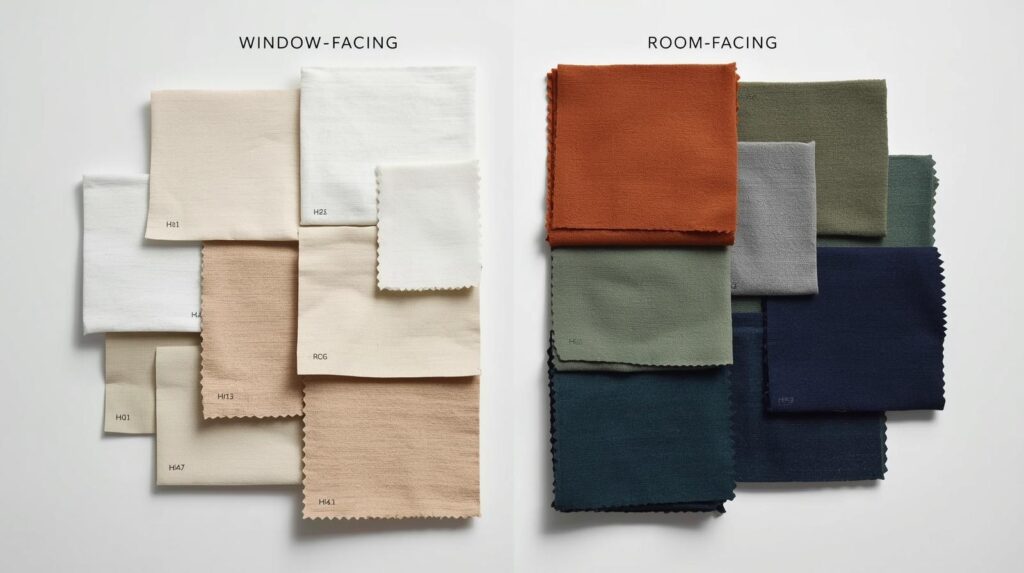
THE TWO-SIDED STRATEGY: HEAT-SMART OUTSIDE, BEAUTIFUL INSIDE
Dubai’s best hotel interior designers have used this approach for years. The principle is straightforward and practical:
- Use a light or white fabric on the window-facing side of the curtain for maximum solar reflection.
- Use your preferred decorative color on the room-facing side for the interior aesthetic you actually want.
Three practical ways to achieve this in a Dubai home:
- A lined curtain where the lining is white or cream-colored, and the decorative fabric faces the room in the tone you prefer.
- A layered system where the sheer layer acts as the reflective surface against the glass, and the heavier drape carries the room’s color story.
- Custom double-sided panels carrying different fabrics on each face – available through specialist curtain suppliers in Dubai who offer made-to-measure services.
This approach lets you use warm terracotta, sage green, or muted olive in a west-facing Dubai living room without raising the room temperature. The reflective surface works against the glass. The decorative color faces inward for you to enjoy.
2026 DUBAI INTERIOR PALETTES – COMPATIBLE WITH HEAT-SMART COLOR CHOICES
The dominant interior design palettes in Dubai’s residential market right now:
- Sandy neutrals and warm beige – reflects well, heat-smart, widely popular.
- Terracotta and burnt sienna accents – light-toned enough to perform on south-facing walls.
- Sage green and dusty olive – mid-tone; works best as room-facing color, not window-facing.
- Off-white and warm cream as base tones – ideal window-facing color for all sun exposures.
- Muted rose and warm taupe as accent shades – compatible with heat-reflective lining underneath.
Colors to handle with care on sun-facing windows in Dubai:
- Deep navy, charcoal grey, forest green, and pure black.
- These absorb significantly more solar heat and should only be used as the room-facing side of a lined or layered system – never as the bare window-facing surface in any direct-sun Dubai room.

ROOM-BY-ROOM CURTAIN GUIDE FOR DUBAI HOMES
Quick reference summary by room:
- Bedroom – Thermal blackout, ceiling-to-floor, bonded lining.
- Living Room – Layered sheer plus thermal drape, ceiling-mounted double track.
- Kitchen – Café-length treated cotton or moisture-resistant roller blind.
- Children’s Room – OEKO-TEX certified blackout, cordless or motorized.
- Home Office – Adjustable sheer or dual-roller blind for precise light control.
- Balcony and Outdoor – Solution-dyed acrylic only, vertical panel format.
BEDROOM CURTAINS FOR DUBAI HOMES
The Dubai bedroom has a clear priority sequence that makes the buying decision straightforward.
Priority order for bedroom curtains in Dubai:
- Blackout quality – complete darkness supports sleep, especially given Dubai’s summer sunrises before 5:30 AM and daylight past 7 PM.
- Thermal insulation – a cooler bedroom requires less AC runtime overnight, directly reducing monthly electricity consumption.
- Dust resistance and washability – practical in Dubai’s environment, where quarterly washing is the minimum maintenance standard.
Recommended configuration:
- Floor-length triple-weave blackout curtains with bonded thermal lining.
- Ceiling-mounted track installed wall-to-wall with zero gaps at any edge.
- Light or cream-colored lining on the glass-facing side for maximum heat reflection.
Dubai-specific installation note: Many Dubai bedrooms have air conditioning vent grilles near or directly above the window. Confirm that ceiling-mounted tracks and floor-length curtains do not obstruct these vents. A blocked vent restricts airflow and makes the room harder to cool – directly counteracting the thermal benefit the curtain is installed to provide.

LIVING ROOM CURTAINS FOR DUBAI APARTMENTS AND VILLAS
The living room demands the most balanced approach of any room in a Dubai home. It needs to handle a mild winter morning, a peak July afternoon, a casual evening, and a formal gathering – without requiring a complete curtain change between each.
The layered system is the correct choice for most Dubai living rooms:
- Sheer layer (inner): Daytime privacy, UV filtration, bright ambient light.
- Thermal drape (outer): Closed during peak afternoon heat; locks in cooled air.
- Double ceiling-mounted track: Both layers operate independently; creates a complete heat seal at the top of the window.
For Dubai villas with high-ceiling reception areas or majlis rooms:
- Ceiling heights of 4 to 5 metres require custom-length panels – standard retail curtain lengths of 2.4 to 2.8 metres are completely inadequate.
- Ceiling-mounted floor-to-ceiling panels create a complete heat barrier from wall to floor and make the space feel proportionally grander.
- Full-height installation eliminates the convective air gap at the top of wall-mounted rods that reduces thermal efficiency by up to 30%.
Explore living room curtain options for Dubai homes and villas at jawincurtain.com/living-room-curtains-dubai to find configurations suited to both standard apartment layouts and villa-scale reception spaces.
KITCHEN CURTAINS FOR DUBAI HOMES
Why heavy drapes fail in Dubai kitchens:
- Cooking grease and desert dust accumulate simultaneously, creating hygiene issues within months.
- Floor-length drapes near cooking areas collect grime at a rate that demands washing every four to six weeks.
- High ambient temperatures near windows and cooking surfaces accelerate fabric degradation faster than in any other room in the home.
What actually works in a Dubai kitchen:
- Short café-length curtains in treated cotton or a synthetic blend – removable and machine-washable at home.
- Roller blinds in moisture-resistant fabric – wipes clean with a damp cloth; the most practical solution for most Dubai kitchen layouts.
- Light-colored fabrics only – dark colors absorb additional heat in an already warm environment and show grease accumulation more visibly.
The guiding rule for kitchen curtains in Dubai: choose something you will actually maintain. A curtain that never gets properly cleaned becomes a dust and grease trap within one summer.
CHILDREN’S ROOM CURTAINS
Two non-negotiable requirements for children’s room curtains in any Dubai home:
- Complete blackout – Dubai’s summer sunrise before 5:30 AM and extended evening daylight directly affect children’s sleep quality and duration. Poor sleep in children compounds into behavioral and developmental consequences.
- Non-toxic, certified-safe materials – in a small, enclosed room where children sleep for eight to ten hours, material safety is not optional.
Material requirements:
- OEKO-TEX Standard 100 certification – independently tested for heavy metals, formaldehyde, pesticide residues, and other harmful substances.
- Avoid PVC-coated blackout linings – at Dubai’s ambient temperatures near windows, PVC coatings can release chemical vapors into children’s sleep environments.
- OEKO-TEX certified alternatives are available across all price ranges and are worth specifying explicitly.
Safety installation requirements:
- All curtain systems in children’s rooms must be cordless or motorized without exception.
- Loose curtain cords and chain pulls are a documented strangulation hazard.
- Motorized systems eliminate this risk entirely while making daily operation easier for parents.
HOME OFFICE CURTAINS
Working from home in Dubai creates a specific challenge: the sun is simultaneously your enemy and your friend. Closing curtains completely produces a dark workspace that reduces alertness. Leaving them open means screen glare, visual fatigue, and uncomfortable heat building during afternoon hours.
What a Dubai home office needs from its curtain system:
- Fine-grained light control – the ability to adjust brightness gradually, not just open or fully closed.
- Glare reduction without full blackout – screen glare is the practical problem, not daylight itself.
- Quick privacy capability for video calls – a panel that can be pulled across rapidly without rearranging the entire window treatment.
The best curtain options for Dubai home offices:
- Adjustable sheer system – continuous fine-grained control over light levels throughout the working day.
- Dual-roller blind – a sheer roller and a blackout roller on one bracket, independently operable as conditions change. One of the most practical solutions in Dubai home office fit-outs.
- Side-draw motorized panel – deployed quickly for video call backgrounds or brief peak-sun moments without disturbing the rest of the window treatment.
BALCONY AND OUTDOOR CURTAINS FOR DUBAI HOMES
The Dubai balcony is the most hostile environment for any fabric in residential use. It simultaneously faces extreme UV, wind-driven sand, temperature extremes from cool evenings to 45°C afternoons, and for coastal properties, salt air humidity as well.
Why solution-dyed acrylic is the only appropriate choice for Dubai balconies:
- Maintains color consistency under extreme UV – protected by solution-dyed construction throughout the fiber, not just on the surface.
- Naturally resistant to water, humidity, and coastal salt air – does not support mold or mildew growth.
- Cleans easily with mild soap and water – no specialist treatment or professional cleaning required.
- The only fabric category independently rated for sustained UAE outdoor sun and weather exposure.
Never use indoor curtain fabrics for balcony or outdoor applications in Dubai. Even UV-treated linen and treated polyester blends degrade significantly faster than rated when exposed to Dubai’s outdoor conditions simultaneously.
The secondary benefit of balcony curtains: shading the balcony itself reduces heat radiating through adjacent sliding glass doors into interior rooms – addressing one of the largest single heat entry points in any Dubai apartment.
Explore outdoor blind and curtain options suited to Dubai’s balcony conditions at jawincurtain.com/outdoor-blinds for materials and formats designed to withstand UAE weather year-round.

HOW THE RIGHT CURTAINS REDUCE YOUR DEWA BILL
Most Dubai residents think of curtains as a home furnishing expense. A more accurate way to think about them – particularly when investing in thermal or blackout performance fabric – is as a passive cooling upgrade with a measurable financial return.
The energy context:
- AC accounts for 60 to 70% of residential electricity consumption in Dubai during summer.
- Windows account for approximately 30% of a building’s total cooling energy use (US Department of Energy).
- Approximately 76% of sunlight falling on standard double-pane windows enters the room as heat (US Department of Energy).
- Thermal draperies with reflective backings reduce solar heat gain by up to 33% (US Department of Energy).
The financial calculation for Dubai homes:
West-facing living room upgrade (one room):
- Investment: AED 1,500 to 2,500
- Estimated annual DEWA saving: AED 600 to 1,200
- Approximate payback period: 1 to 2 summers
Full apartment upgrade (three sun-facing rooms):
- Investment: AED 4,000 to 7,000
- Estimated annual DEWA saving: AED 1,500 to 3,000
- Approximate payback period: 2 to 3 summers
Villa west and south-facing room upgrade:
- Investment: AED 8,000 to 15,000
- Estimated annual DEWA saving: AED 3,000 to 6,000
- Approximate payback period: 2 to 3 summers
The compounding effect of DEWA’s tiered pricing: Because higher monthly consumption pushes usage into progressively more expensive rate bands, reducing consumption by even 10% can drop you out of the highest-cost band entirely – producing savings proportionally larger than the raw percentage reduction suggests.
Every summer after the payback period is pure gain.

DUBAI APARTMENT VS. VILLA: DIFFERENT PRIORITIES, DIFFERENT SOLUTIONS
The approach to curtains in a Dubai apartment and a Dubai villa must be genuinely different – not just in scale, but in the specific structural constraints, architectural features, and practical priorities each property type creates.
CURTAINS FOR DUBAI APARTMENTS
Common challenges specific to Dubai apartments:
- Rental drilling restrictions – many landlords in JVC, Al Barsha, Discovery Gardens, and Dubai Sports City restrict wall drilling, eliminating the standard wall-mounted rod approach.
- Continuous glass runs – modern Dubai towers built after 2005 frequently have single continuous window runs across entire room widths rather than individual window openings.
- Off-the-shelf sizing limitations – standard retail curtain panel widths are designed for individual windows and rarely match the continuous glass runs of Dubai high-rise apartments.
- Urban noise factor – properties in Deira, Bur Dubai, Downtown, and Al Barsha face significant traffic noise; heavier curtain fabric provides meaningful secondary acoustic insulation.
Practical solutions suited to Dubai apartments:
- Ceiling track systems with compression brackets – apply pressure rather than drilling; suitable for plasterboard partition walls.
- Adhesive rail systems – appropriate for lighter sheer fabrics in units where no hardware installation is permitted.
- Custom-width panels – essential in most Dubai apartment layouts; off-the-shelf widths leave heat-entry gaps on both sides of continuous glass runs.
- Heavier fabric selection – in noisy urban locations, denser curtain fabric provides meaningful secondary acoustic insulation alongside thermal protection.
CURTAINS FOR DUBAI VILLAS
Common challenges specific to Dubai villas:
- Bifold and sliding glass doors – wider than conventional windows, at floor level, required to clear the full door width when open without restricting outdoor access.
- Double-height ceilings – majlis areas and reception rooms with ceiling heights of 4 to 5 metres; standard retail lengths of 2.4 to 2.8 metres are completely inadequate.
- Garden-facing exposure – simultaneous wind, dust, and full afternoon sun; curtain heading tape durability under frequent daily operation is critical.
- Multiple AC zones – villa properties have several independently controlled zones; curtain performance in specific rooms has a more isolated and measurable impact on individual zone energy costs.
Practical solutions suited to Dubai villas:
- Stacked panel system on a full-width ceiling track – the only configuration that genuinely addresses bifold and wide sliding door openings.
- Custom-length panels – required for any room with ceiling heights above standard residential dimensions.
- Heavy-duty heading tape – specified to withstand the mechanical stress of frequent daily operation in Dubai’s conditions.
- Professional ceiling track installation – mandatory at 4 to 5 metre heights; requires specialist equipment and UAE-specific building construction experience.
Find out more about professional curtain measurement and installation services across Dubai and the UAE at jawincurtain.com/installation – including ceiling-height villa installations and continuous-glass apartment configurations.
CURTAIN MAINTENANCE CALENDAR FOR DUBAI’S CLIMATE
The UAE environment demands a more active maintenance approach than most homeowners expect. Fine dust accumulation, coastal salt air, and sustained UV exposure that gradually weakens fabric fibers all mean that curtains left without regular care deteriorate significantly faster than their rated lifespan.
Here is the complete Dubai curtain maintenance calendar:
WEEKLY – Light Dust Removal
Action: Lightly vacuum curtains using a soft brush attachment, or give each panel a gentle shake-out outdoors.
Why it matters: Fine PM2.5 dust accumulates on curtain surfaces daily, not just during visible dust events. Removing surface dust before it embeds into the fiber weave is far easier than washing embedded particles out later. This takes two to three minutes per panel.
Peak priority months: March through May and October through November, when shamal winds increase airborne particulate matter substantially.
MONTHLY – Track and Hardware Cleaning
Action: Wipe down the curtain track, rod, and all bracket hardware with a damp cloth.
Why it matters: Dust accumulates on tracks and transfers back onto clean curtain fabric. This is one of the most commonly skipped steps in curtain maintenance – and one of the most useful for extending the time between full washes.
EVERY THREE MONTHS – Full Fabric Wash
Action: Full wash per the fabric’s care label, or professional dry clean for lined and thermal curtains that specify it.
Why quarterly washing is the minimum standard in Dubai:
- Annual washing – recommended in most Western curtain care guides – is not sufficient in UAE conditions.
- Desert dust particles left unwashed embed progressively deeper into fiber structures, causing persistent odor.
- Unwashed dust causes premature fiber breakdown from abrasive embedded grit.
- Gradual greying develops that becomes increasingly difficult to reverse.
- Increased indoor allergen levels are released continuously into the room air.
ANNUALLY – Full Structural Inspection
Action: Examine every panel for signs of UV degradation and construction failure.
Signs that your Dubai curtains need replacing:
- Uneven fading between sun-exposed and shaded sections of the same panel.
- Brittleness or cracking at the top hem – the heading tape area degrades first under sustained UAE UV.
- Visible lining separation – bubbling, peeling, or flaking on thermal or blackout panels.
- Fabric that feels paper-thin when held to light – UV-driven fiber breakdown has reached structural weakness.
- Persistent odor despite repeated washing – deep fiber contamination that surface cleaning cannot reach.
AFTER A SANDSTORM – Critical Protocol
Action: Vacuum curtains thoroughly before any wet cleaning.
Why this step is critical and counterintuitive: Haboob-level sandstorms deposit concentrated fine grit onto curtain surfaces and into the fabric weave. Wet-washing before removing surface grit first turns loose particles into a suspended abrasive slurry that embeds deeper into the fiber during washing agitation. The resulting damage is far harder to reverse than the original dust deposit.
The correct post-sandstorm cleaning sequence:
- Allow curtain surfaces to dry completely after the storm passes.
- Vacuum thoroughly with a soft brush attachment on low suction.
- Shake panels outdoors if weight and fabric type allow.
- Only then proceed with wet cleaning or a professional wash.

WHY PROFESSIONAL CURTAIN INSTALLATION MATTERS MORE IN DUBAI
The best curtain fabric available, improperly installed, will not deliver the thermal performance it is designed to provide. In Dubai, proper installation involves specific challenges tied to UAE building construction that most DIY guides and international tutorials do not address.
UAE BUILDING MATERIALS ARE NOT STANDARD
Dubai’s buildings – whether a 2005-era Deira tower, a JVC townhouse, or a new villa in Dubai Hills Estate – are constructed from reinforced concrete with gypsum board internal partitions. These are two entirely different substrates requiring:
- Different anchor types and drill bit specifications.
- Different load-bearing assessment before any bracket is installed.
- Different fixing torque specifications to ensure long-term hold under weight and vibration.
The standard plastic wall plug and machine screw that holds reliably in timber-framed European or North American walls will not hold adequately in concrete and will fail under load in gypsum board. Using the wrong fixing creates a genuine safety risk – particularly for heavy custom-width thermal curtain systems – and causes brackets to pull away from walls under daily operational weight.
THE HEAT GAP PROBLEM
A curtain hung 5 to 8 centimetres below the ceiling on a wall-mounted rod – rather than on a ceiling-mounted track flush with the ceiling surface – loses measurable thermal performance through the gap above the panel. Hot air rises over the top of the panel and circulates into the room, bypassing the insulating fabric entirely.
This convective bypass can reduce a thermal curtain’s effective performance by up to 30% – even when the fabric quality is excellent.
Ceiling-mounted tracks eliminate this gap entirely:
- The track runs flush with the ceiling surface.
- The curtain hangs with no gap above the panel.
- The full thermal performance of the fabric is realised rather than partially bypassed.
This is not a minor detail. It is the single most important installation factor in determining whether a Dubai curtain performs as specified.
AC VIBRATION – A DUBAI-SPECIFIC CONCERN
Dubai’s air conditioning systems run for 10 to 18 hours per day during summer months. That sustained mechanical vibration is transmitted through walls and ceilings continuously for months at a time. Low-quality bracket hardware loosens progressively under this vibration load. A bracket that feels secure on installation day can be visibly loose within a single summer season without proper anchoring.
Professional installation with correctly specified fixings, tightened to the appropriate torque for the substrate type, eliminates this problem permanently.
The professional installation service available across Dubai at jawincurtain.com/installation includes substrate assessment, correct anchor specification, ceiling track fitting for villa and apartment heights, and post-installation checks – all conducted by technicians experienced with UAE building construction.
FREQUENTLY ASKED QUESTIONS
What type of curtains are best for Dubai’s heat?
Thermal blackout curtains with triple-weave construction and bonded lining are the most effective. For living areas, a layered sheer-plus-thermal-drape system gives flexible heat protection across all hours without sacrificing daytime light.
Do blackout curtains really block heat in UAE homes?
Yes – when installed correctly. They reduce solar heat gain by up to 33% according to US Department of Energy research. Zero-gap installation – ceiling-mounted, floor-to-ceiling, wall-to-wall – is the critical factor that determines actual performance.
What is the best fabric for curtains in a hot climate like Dubai?
Triple-weave polyester with bonded thermal lining performs best in west and south-facing rooms. Solution-dyed acrylic is the best choice for balconies and outdoor areas. UV-treated linen blends offer the best balance of aesthetics and performance for living rooms and dining areas.
What color curtains are best for blocking heat in Dubai?
Light colors – white, cream, sand beige, and light grey – reflect solar radiation and keep rooms cooler. Dark curtains can raise indoor temperatures by 3 to 5°C even when fully closed, because they absorb rather than reflect solar energy.
Are linen curtains suitable for Dubai’s climate?
Yes, but only with proper treatment. UV-treated linen blends or linen curtains with a thermal lining perform well in living areas. Untreated pure linen fades unevenly within one to two seasons under UAE-level UV radiation.
How often should I clean my curtains in Dubai?
Every three months as a minimum. Dubai’s PM2.5 and PM10 dust particles accumulate continuously in curtain fibers. After a sandstorm, always vacuum curtains before wet cleaning to avoid embedding grit deeper into the fabric weave.
Are motorized curtains worth it in Dubai?
Yes – particularly for rooms with large glass facades or households where curtains are regularly left open during peak heat hours. Automated scheduling during the 12 PM to 4 PM heat window delivers measurable DEWA savings across every five-month Dubai summer season.
How do I stop curtains from fading in Dubai’s sunlight?
Choose solution-dyed fabrics over surface-dyed ones. Add a UV-blocking lining to any natural fabric such as linen or cotton. Ensure the window-facing side of the curtain is light-colored to reflect rather than absorb UV radiation.
What curtains are best for west-facing windows in a Dubai apartment?
Triple-weave thermal blackout curtains with bonded lining, installed ceiling-to-floor on a ceiling-mounted track with zero edge gaps. West-facing windows receive the most aggressive afternoon sun of any orientation in Dubai – no lighter treatment manages the heat load adequately.
Can curtains lower my DEWA electricity bill in Dubai?
Yes. AC accounts for 60 to 70% of Dubai’s residential electricity consumption in summer. Thermal curtains reducing solar heat gain by up to 33% directly reduce AC load – with a payback period of one to three summers depending on the number of sun-facing rooms treated.
FINAL RECOMMENDATION: BEST CURTAINS FOR DUBAI HOMES
Dubai’s climate does not moderate itself to accommodate average products. Every summer, it tests everything placed in its path – and curtains are no exception. Getting this decision right has a direct and measurable impact on comfort, furniture longevity, indoor air quality, and the monthly DEWA bill.
The right curtain choice for any Dubai home follows three decisions, made in the right sequence.
Step 1 – Identify your window’s sun direction:
- West-facing: Maximum thermal blackout – no compromise on coverage or construction.
- South-facing: UV-reflective, fade-resistant materials applied consistently year-round.
- East-facing: Breathable sheers or UV-treated linen with moderate protection.
- North-facing: Easy-clean, aesthetics-led choices with dust resistance as the priority.
Step 2 – Match fabric and construction to what that window actually requires:
- West-facing bedrooms: Triple-weave polyester with bonded thermal lining.
- South-facing living areas: UV-treated linen blends or solution-dyed fabrics.
- Children’s rooms: OEKO-TEX certified blackout, cordless or motorized.
- Balconies and outdoor areas: Solution-dyed acrylic only – no exceptions.
- Rooms needing all-day adaptability: Layered sheer-plus-thermal-drape on a double ceiling track.
Step 3 – Install it correctly:
Ceiling-mounted. Floor-to-ceiling. Wall-to-wall. Zero gaps at every edge.
Even the highest-quality fabric loses up to 30% of its thermal effectiveness through improper installation. In a climate as demanding as Dubai’s, that gap between potential and actual performance costs you in comfort, furniture lifespan, and electricity every single month.
Curtains in Dubai are not a decorating decision. They are a climate management decision that happens to also affect how your home looks. Made correctly, that decision:
- Pays for itself in DEWA savings within one to two summers.
- Protects furniture and flooring from premature UV degradation.
- Improves sleep quality through genuine blackout performance.
- Reduces indoor dust and allergen levels measurably.
- Makes your home genuinely more comfortable to live in through every Dubai summer.
If you want help choosing the right solution for your specific rooms, window orientations, and building type, expert guidance and a free home measurement visit are available across Dubai and the wider UAE.
Whether you need blackout curtains for a Dubai bedroom , sheer curtains for a living area, motorized systems for a large glass facade, linen curtains for your villa living room, or a full home consultation (jawincurtain.com/contact-us) – professional measurement, fabric advice, and expert installation are all included at no extra cost.
Whether you need a single bedroom solution or a complete apartment project with motorised double-track systems throughout, we work with your specific windows, your budget, and your timeline.
 Call or WhatsApp: +971 52 525 7882
  Visit our showroom: Dragon Mart 1, Al Aweer Road, Dubai – see fabrics and styles in person before committing.
  Browse our full range: Explore home curtains Dubai, blackout curtains, sheer curtains, motorised curtains, roller blinds, and outdoor blinds.